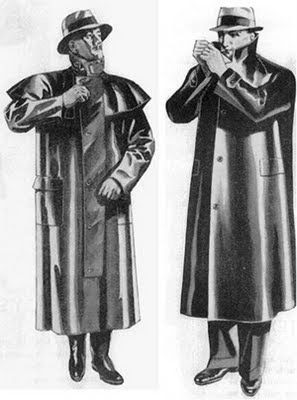
The Mackintosh
The Mackintosh, often simply called a mac, is a classic waterproof raincoat first introduced in 1824. It is made from rubberised fabric and takes its name from its Scottish inventor, Charles Macintosh. Although early spellings sometimes included an extra “k” (Mackintosh), this version has since become the standard.
While the term “mackintosh” is now used generically for raincoats, a true Mackintosh is still defined by its distinctive construction: a layer of rubber bonded between two layers of fabric, creating a durable and fully waterproof material.
The origins of this innovation are occasionally disputed. Some credit the surgeon James Syme, but it was Macintosh who successfully patented and commercialised the process. His breakthrough involved dissolving rubber in naphtha (a tar-derived solvent) and sandwiching it between fabric layers. Earlier waterproofing techniques—such as those used by the Aztecs, who coated textiles with latex—demonstrate that the idea itself was not entirely new. However, Macintosh’s method made waterproof clothing practical on an industrial scale.
In 1830, Macintosh’s company merged with that of Thomas Hancock in Manchester, another pioneer in rubber technology. Hancock later patented the process of vulcanisation in 1843, which significantly improved the durability, flexibility, and smell of rubberised fabrics. This advancement helped solve early issues such as stiffness in cold weather and melting in heat.
By the mid-19th century, rubberised coats were widely produced across the UK and used by institutions such as the British Army, railway workers, and police forces. The Mackintosh became not just a practical garment but a symbol of British industrial innovation.
In 1925, the company was acquired by Dunlop Rubber, marking a new phase in its industrial history. However, by the 1990s, the brand—then operating under Traditional Weatherwear—faced serious decline and nearly shut down its factory in Cumbernauld, Scotland.
A turnaround came in the early 2000s, when management revitalised the brand as a premium fashion label. Mackintosh began collaborating with luxury houses such as Gucci, Hermès, Louis Vuitton, and Liberty. These partnerships helped reposition the coat as both a heritage item and a high-end fashion statement, particularly popular in Japan.
The brand received a Queen’s Award for Enterprise in 2000 for its success in international trade, reflecting its global resurgence. In 2003, the company officially adopted the name Mackintosh.
In 2007, the brand was acquired by the Japanese firm Yagi Tsusho, further strengthening its presence in international markets. Since then, Mackintosh has continued to expand, opening flagship stores—including its first in London in 2011—and maintaining its reputation for craftsmanship.
Today, the Mackintosh remains an iconic blend of tradition and modernity. Still handcrafted in Scotland using time-honoured techniques, it has become a staple in contemporary fashion, worn by celebrities and featured in global runway collections. Its clean lines, minimalist design, and enduring functionality ensure that it remains as relevant in the 21st century as it was nearly two centuries ago.