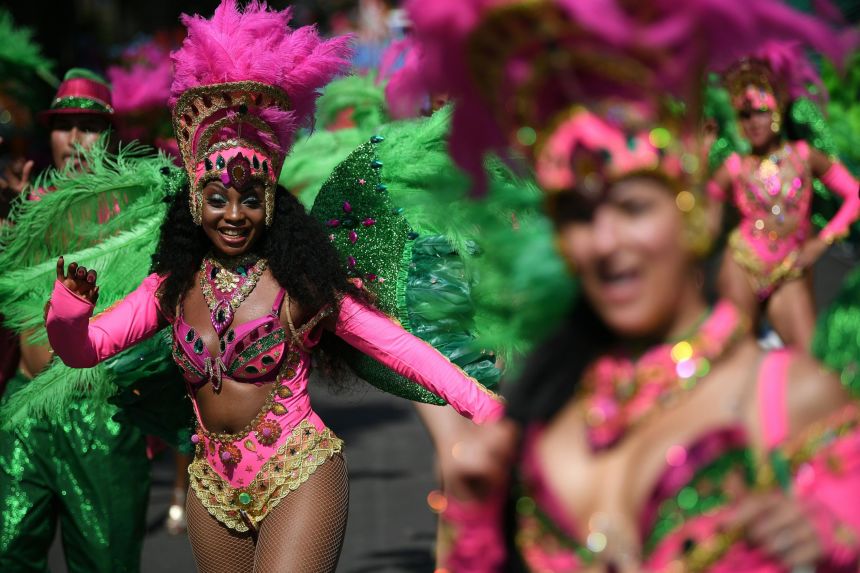
Notting Hill Carnival
Notting Hill Carnival is one of London’s most iconic events and the largest street festival in Europe. Each year, over two million people gather in West London to celebrate Caribbean culture through music, dance, food and dazzling costumes. What began as a small community initiative has become an internationally recognised celebration of resilience, identity and joy.
The origins of the Carnival are deeply rooted in social struggle. In the late 1950s, following the Notting Hill race riots and the murder of Antiguan carpenter Kelso Cochrane in 1959, the local Caribbean community sought ways to foster unity and pride. Activists such as Claudia Jones, often called the “Mother of Caribbean Carnival” in Britain, began organising indoor events that showcased Caribbean music, dance and food. By 1966, thanks to community organisers like Rhaune Laslett, Leslie Palmer and Duke Vin, these indoor gatherings evolved into an outdoor festival in the streets of Notting Hill. From its beginnings as a grassroots initiative, the Carnival grew steadily, reflecting the rhythms of calypso, soca and reggae, and incorporating steelpan bands and elaborate masquerade costumes.
Over the decades, Notting Hill Carnival has expanded into a cultural phenomenon. Today it represents five core disciplines of Caribbean carnival tradition: masquerade, calypso, soca, steelpan and sound systems. The event is more than just entertainment; it is a celebration of Caribbean heritage in Britain and a living archive of diasporic culture. It also carries significant economic weight, bringing an estimated £93 million into the local economy each year, far outweighing the £6 million spent on policing and safety.
The modern Carnival unfolds over three days during the August bank holiday. On Saturday, the Panorama steelband competition takes place in Emslie Horniman’s Pleasance Park, attracting enthusiasts of steelpan music from across the country. Sunday, often referred to as Family Day, begins with the early morning J’Ouvert celebrations, where revellers cover themselves in paint and powder, followed by the Children’s Parade. It is a day filled with colour, joy and inclusivity, with dozens of sound systems and live stages operating until the evening. Monday is the climax, when the Adults’ Parade takes over the streets with spectacular costumes, pulsating rhythms and energetic performances that carry on until 7 p.m. Both Sunday and Monday also include a moment of reflection: a 72-second silence at 3 p.m., held in memory of the victims of the Grenfell Tower fire.
The route of the parade winds through Westbourne Park, Chepstow Road, Westbourne Grove and Ladbroke Grove, covering about three and a half miles. Alongside the music and performances, food plays an equally important role. Around 300 stalls offer Caribbean delicacies such as jerk chicken, curry goat, patties, fried plantain and ackee and saltfish, while also catering to vegetarian and vegan visitors. The sounds are just as diverse, ranging from reggae and soca to dancehall, hip hop, funk and samba, creating an atmosphere that reflects the cultural diversity of London itself.
Despite its success, Notting Hill Carnival faces significant challenges. Policing and safety are constant concerns, with hundreds of arrests reported each year. In 2025, authorities introduced new surveillance measures such as drones and live facial recognition, sparking debate over civil liberties. Financial difficulties also loom: Carnival organisers rely heavily on last-minute funding from local councils, and many food vendors struggle with rising costs and taxes. On a broader scale, gentrification in Notting Hill threatens the cultural roots of the festival, as the area’s Caribbean community continues to shrink due to rising rents and displacement.
Yet, despite these obstacles, Notting Hill Carnival remains a vital part of Britain’s cultural landscape. For many, it is more than a party; it is a living symbol of resilience, resistance and identity. It stands as a reminder of the contributions of the Caribbean diaspora to British society, and as an annual affirmation of community spirit, creativity and cultural pride.
Notting Hill Carnival in 2025 takes place over the August Bank Holiday weekend, specifically: August 23rd to 25th.