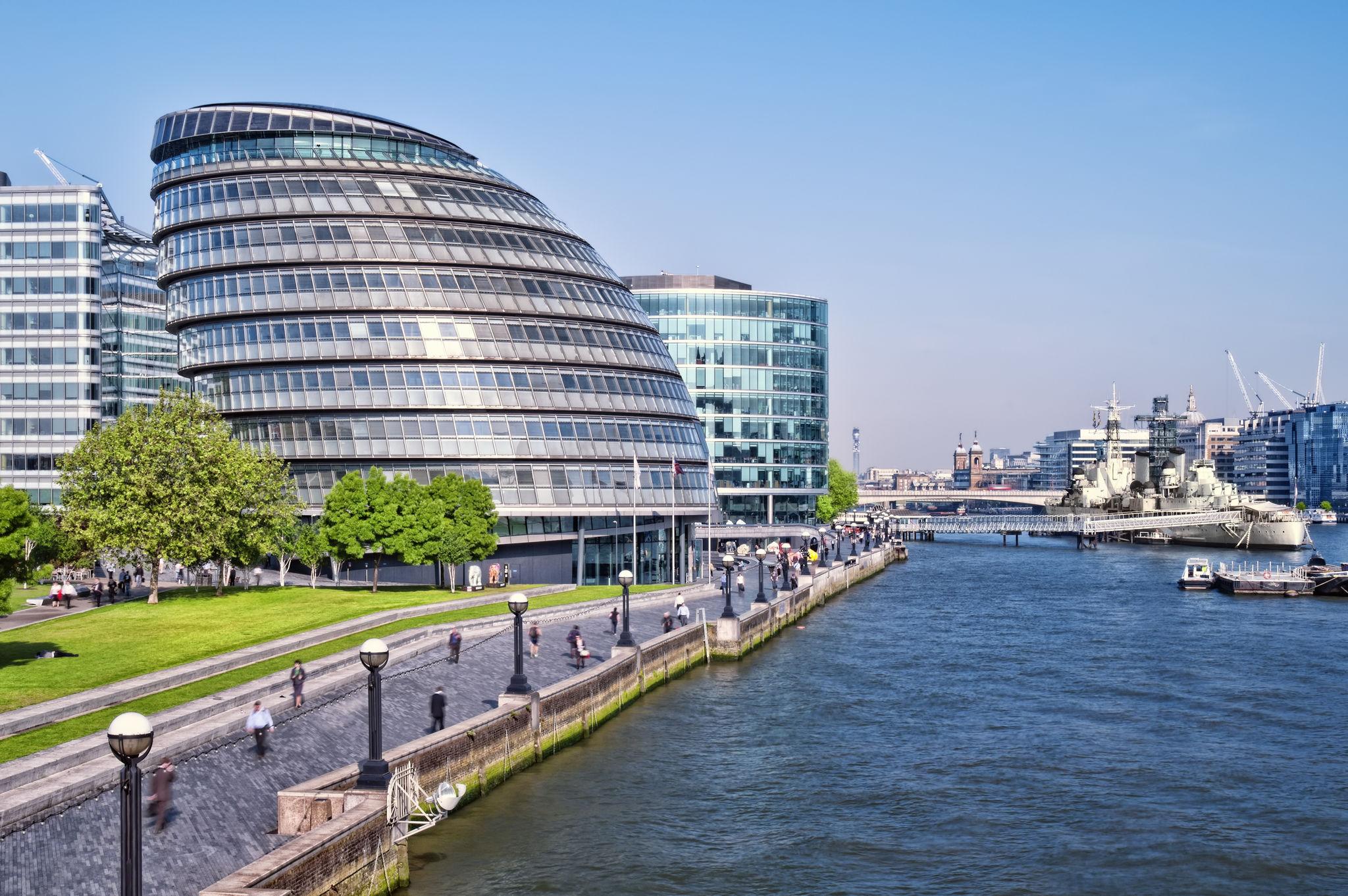
The London City Hall
The London City Hall is one of the most modern and recognisable buildings in the British capital. It is the headquarters of the Greater London Authority (GLA), which includes the office of the Mayor of London and the London Assembly. The building stands on the south bank of the River Thames in the district of Southwark, close to the famous Tower Bridge.
The building was designed by the world-famous British architect Norman Foster, whose futuristic ideas helped transform modern architecture around the world. He also worked on the renovation of the German parliament building, the Reichstag Building, in Berlin. London City Hall officially opened in 2002 and cost approximately £43 million to build.
What immediately attracts attention is the building’s strange and unusual shape. Unlike traditional buildings, City Hall has no clear front or back. Its curved, almost spherical design was created to reduce energy consumption and improve efficiency. In fact, the rounded form gives the building about 25% less surface area than a normal cube-shaped structure of the same size. This helps keep the building warmer in winter and cooler in summer.
However, Londoners quickly began comparing the building to many strange objects! Some people said it looked like a motorcycle helmet, a giant egg, or even a woodlouse. Former Mayor of London Ken Livingstone jokingly called it “a glass testicle”, while another former mayor, Boris Johnson, preferred the nickname “The Onion”. These humorous nicknames became very popular in the British media.
One of the most fascinating features inside the building is its enormous spiral walkway. Instead of using only lifts or staircases, visitors can walk up a 500-metre helical ramp that winds around the interior of the 10-storey building. The walkway creates a dramatic open space and symbolises transparency in politics — the idea that government should be open and visible to the public.
At the very top of the building is a public exhibition and meeting area known as “London’s Living Room”. From there, visitors can enjoy spectacular panoramic views across the River Thames and many famous London landmarks.
Next to City Hall is an open-air amphitheatre called The Scoop. The Scoop hosts free outdoor events during the summer, including theatre performances, concerts, film screenings, and public discussions. Its name comes from its shape, which looks as though a giant spoon has scooped part of the ground out beside the building.
The construction of City Hall required enormous quantities of materials: around 2,100 tonnes of steel, over 13,000 square metres of concrete, and 7,300 square metres of special triple-glazed glass designed to improve insulation. Despite its eco-friendly ambitions, some critics argued that the building’s extensive use of glass actually increased energy consumption.
Today, London City Hall remains one of the capital’s most distinctive modern landmarks and an important symbol of London’s political life, innovation, and contemporary architecture.
Interesting Trivia & Anecdotes. Did you know?
The building’s unusual shape was designed to help save energy.
The spiral ramp inside is longer than five football pitches combined!
“The Onion” became one of the building’s most famous nicknames.
City Hall was designed to represent transparency and openness in government.
The Scoop often hosts free cultural events during summer evenings.
Many tourists mistake the building for a museum or an art gallery rather than a government office.